


Strategic Investment Plan (SIP) workshop on pork value chain at Tsirang
A Strategic Investment Plan (SIP) is a comprehensive, forward-looking document that outlines priority investment areas, funding needs, and implementation strategies to achieve long-term impact of the project. It serves as both a policy guide and a resource mobilization tool. It is in pursuit of development goal of BRECSA i.e catalyze a 30% increase in resilient commercial agricultural production and improve food and nutrition security in the four target districts by 2030. It is also a sincere attempt of the MoAL to transition agriculture from subsistence to commercial to achieve Nu. 50 billion contribution GDP.
The SIP(s) is being developed based on the principles of value chain application where benefit, costs, and a competitive advantage are analyzed. The SIP will guide investment decision, attract co-funding, and enhance resilience, productivity and competitiveness. Project Management Unit (PMU) of BRECSA with technical support from RAMCO and WFP, TA conducted SIP development workshops.
SIP for Pork Industry in Tsirang
A three-day workshop was convened on12th June 2025 at Hotel Dejung, Tsirang to brainstorm and conceive SIP for pork and chicken value chains. Forty people (2 female, 38 male) participated in the workshop including Dzongkhag & Gewog livestock officials, Commercial Farmers and representatives of Karma Feed, BLDC, UDOR Feed, Shangri-la Enterprise and prominent piglet breeders and Hatcheries. The linkages between value chain actors identified during Multi-Stakeholders Platform (MSP) conducted last year is further strengthened.
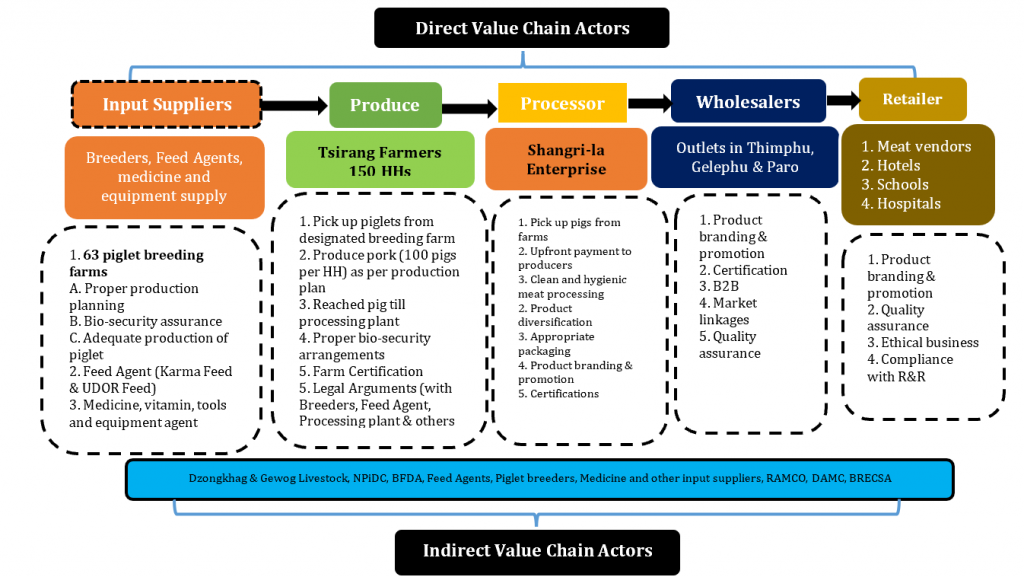
The workshop identified 150 commercial farmers willing to engage in commercial farming of pig with minimum capacity of 200 per year. In total commercial farmers agreed to produce 100 pigs per day starting from next fiscal year. In principle M/S Shangri-La Enterprise agreed to do the processing of pork. However, the enterprise requested the farmers to supply at least 100 pigs per day to make the processing plant economically viable. The enterprise is requesting the concerned Government authorities to allocate the space in Changchey Industrial Park.
M/S Shangri-la will also do the product promotion, advertisement and marketing of pork within and outside country provided there is enough volume.
To get clear pictures of profitability, cost of production (COP) and margin analysis is done separately based on value chain actors. The actual COP of the pork is coming to Nu. 343.19, when analyzed for management of 100 pigs in farmers’ field. Keeping profit margin of 15% the farm gate price is coming of Nu. 411.83.
| Value Chain Actor | COP (Nu.) | Margin (Nu./Kg) | Selling Price (Nu.) | Total Margin (Nu.M) | Gross Income (Nu.M) |
| Breeders (piglet) | 6657.5 | 998.6 | 7656.2 | 29.96 | 229.69 |
| Producers | 343.19 | 68.64 | 411.83 | 175.03 | 1050.17 |
| Processors | 411.83 | 205.91 | 617.74 | 525.07 | 1297.25 |
Annually, the production and marketing of pork in Tsirang is expected to earn our farmers the total gross income of Nu. 1050.17 million. The piglet breeders alone expected to earn gross income of Nu. 229.69 million. Therefore, there is huge scope to enhance the GDP contribution of agri-food sector from pork production.
| Parameters | Farming 100 Fattening | Farming 50 SOWs |
| Net Present Value (NPV) | 5,543,827.69 | 17291121.7 |
| Return on Investment (ROI) | 24% | 57% |
| Cost of Production (COP) | 343.19 | 6657.5 |
| B/C Ratio | 1.24 | 1.6 |
| Margin (20%) | 68.64 | 998.6 |
| FGP | 411.83 | 7656.2 |
Discounted cash approach is used to see the economic feasibility of fattening farms as well as the piglet breeding farms. Analysis shows that both fattening and piglet farming are economically feasible with ROI of 24% and 57% respectively.